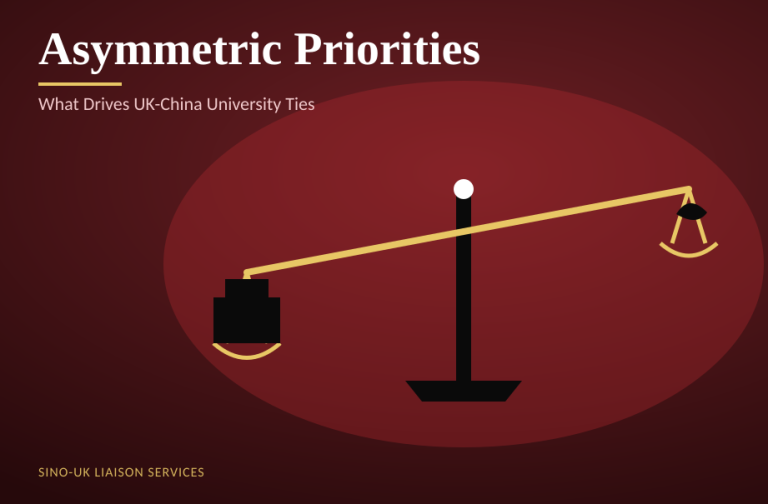
Asymmetric Priorities: What Really Drives UK–China University Partnerships
Published 13 March 2026 | By Sino–UK Liaison Services
After many years working with universities in both the UK and China, one thing has become very clear to us: successful partnerships begin with understanding what matters most to your partner.
People sometimes assume that both universities are looking for the same outcome. In reality, they often come to the table with different priorities—and that's not a problem. In fact, it's often what makes a successful partnership possible.
Different Priorities, Shared Success
For many UK universities, international partnerships have become an essential part of their long-term strategy. With domestic tuition fees remaining frozen and operating costs continuing to rise, partnerships with overseas institutions help create sustainable income through initiatives such as transnational education (TNE), articulation agreements and joint programmes. They also open doors to collaborative research, international networks and access to talented students, particularly in STEM disciplines.
Chinese universities, however, often approach partnerships from a different perspective. In our experience, they're usually thinking about where the institution wants to be in five or ten years' time. They're looking for reputable international partners who can help strengthen teaching, expand research collaboration, enhance their international reputation and, ultimately, contribute to national prestige. Areas such as artificial intelligence, engineering, healthcare and green technology are becoming increasingly important as universities prepare students for the future.
Understanding these different priorities often determines whether a partnership develops into a successful long-term collaboration or struggles to move beyond the initial agreement. When both institutions appreciate what the other hopes to achieve, it becomes much easier to build trust, manage expectations and develop programmes that deliver real value for everyone involved.
The Role of a Liaison Partner
This is where we believe a good liaison partner adds real value.
It's not simply about arranging meetings or translating documents. It's about understanding what matters to each institution, helping both sides communicate openly, and ensuring expectations are aligned from the outset.
When universities understand each other's priorities, partnerships are built on trust rather than assumptions. That creates relationships that are far more likely to grow and succeed over the long term.
Bottom Line
The most successful partnerships are those where different priorities complement one another to create shared value. Universities strengthen their teaching and research, students gain valuable international opportunities, and both countries are better placed to tackle global challenges while building lasting relationships that benefit universities and society as a whole.
We welcome your thoughts on this topic. If you'd like to discuss UK–China university partnerships, please get in touch with us. consulting@sinoukls.com
This piece is intended as informal commentary to encourage discussion, not as a formal statement of policy.